💖 Beyond Blame: Learning to Engage with Your Triggers
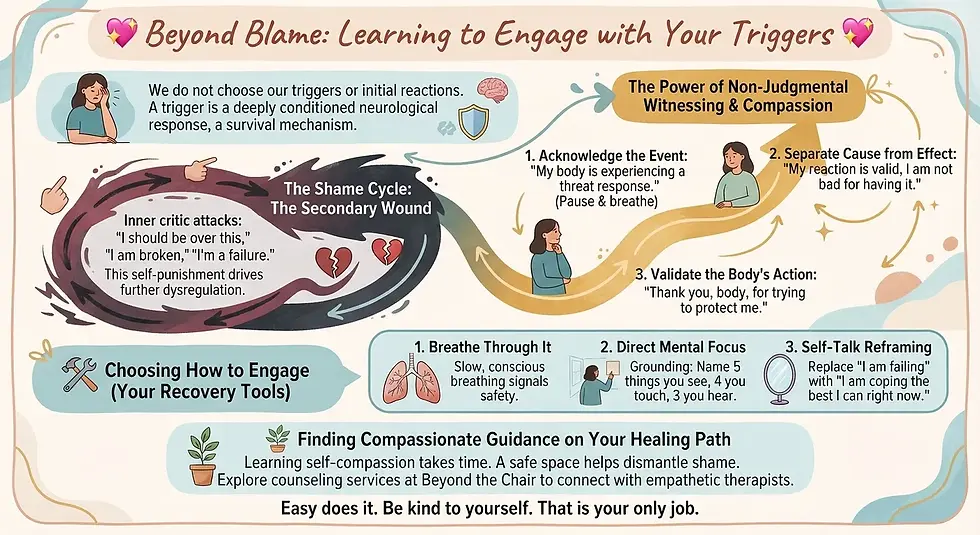
One of the most frustrating and often misunderstood aspects of trauma recovery is the experience of being triggered. A sudden sound, a certain smell, or an unexpected tone of voice can instantly throw your nervous system into a state of panic, rage, or collapse.
Here is a necessary truth: We do not choose our triggers or our initial reactions.
A trigger is a deeply conditioned neurological response. It’s a survival mechanism firing off, interpreting a current moment as a replay of a past danger. You cannot intellectually stop this immediate, involuntary cascade of stress chemicals.
But here is the empowering truth: We CAN learn to choose how we engage with them.
We can learn how we talk to ourselves about them, how we direct our mental focus when they hit, how we breathe through them — but it’s real important we NOT slip into shame or self-blame. Easy does it.
The Shame Cycle: The Secondary Wound
When a trigger hits and you have an intense, involuntary reaction (a panic attack, a sudden shutdown, an explosive burst of anger), the inner critic immediately swoops in with toxic self-blame:
“I should be over this by now.”
“I am broken for reacting this way to something so small.”
“I’m a failure at recovery.”
This shame cycle is the secondary wound. Your body is already struggling to regulate after the trigger, and then your mind attacks it, driving you further into dysregulation. This self-punishment often makes the recovery process harder than the original trauma symptoms themselves.
🧠 The Power of Non-Judgmental Witnessing
The work of engaging with a trigger compassionately begins with separating the event from your identity:
Acknowledge the Event: When the wave of panic or fear hits, the first choice you can make is internal: acknowledge, without judgment, that your system has been activated. State simply: “My body is currently experiencing a threat response.”
Separate Cause from Effect: The trigger is the cause (the past being replayed). The shame is the negative effect you can choose to interrupt. Say: “I am having an intense reaction, and that reaction is valid. I am not a bad person for having it.”
Validate the Body’s Action: Remember, your reaction (Fight, Flight, Freeze, or Fawn) was a survival skill. Thank your body for trying to protect you.
🛠️ Choosing How to Engage
You may not be able to choose the trigger, but you can choose the response that follows the first involuntary reaction. This is where your tools come in:
Breathe Through It: Slow, conscious breathing is the fastest way to signal safety to your nervous system. Focus on extending the exhale. This is an act of agency you choose despite the panic.
Direct Mental Focus: When the mind is racing with catastrophic thoughts, use grounding techniques to anchor it to the present. Name five things you can see, four things you can touch, three things you can hear. This pulls your attention away from the looping fear and toward present safety.
Self-Talk Reframing: Immediately interrupt the inner critic. Replace “I am failing” with “This is hard, and I am coping the best I can right now. I am safe in this moment.”
Easy does it. Choosing to engage with compassion is not a grand gesture; it’s a series of small, gentle choices repeated until they become a new pattern. Your only job is to be kind to yourself in the face of the trigger, not to eliminate the trigger itself.


Comments